Turn
Thinking and Believing into Doing and Serving
Psalm
37.3 John 12.26
Third Sunday in Lent - The Unobvious Series
Rev.
Matthew M. Fry
As we continue to
experience The Word of the Lord together, Let us Pray. Lord, Open our
hearts and minds by the power of your Holy Spirit, that, as the
Scriptures are read and Your Word Proclaimed, we may hear with joy
what you have to say to us today. Amen.
Hear now The Word of
the Lord as it comes to us in Psalm 37. Listen for God’s Word
for you today. Psalm
37.3. “Trust in
the Lord, and do good; so you will live in the land, and enjoy
security.” The Grass Withers, The Flower Falls, but The Word of
The Lord endures forever…Thanks
be to God. And now
hear The Word of the Lord as it comes to us in the Gospel of John.
Listen. John 12.26.
“Whoever serves me must follow me, and where I am, there will
my servant be also. Whoever serves me, the Father will honor.”
The Word of the Lord…Thanks
be to God.
I love my theology.
Not that theology is mine, but I love my particular understanding of
theology, and what I believe to be good theology, and what I want to
leave behind as bad theology. You probably won’t have to think
too hard to compile a list of what I accept to be good theology and
what I consider to be poor theology.
And I love to talk
about theology, to talk about belief in God with people. Literally,
theology is a Greek word, I show you the root of that word is Greek.
It is from two words, Theos, which means God, and logos, which means
word. So, theology is literally, words about God. It is how we
formulate words that describe the indescribable.
And I have spent
lots of time, and mounds of money, going to school to become
theologically literate and well-spoken. I majored in Religion /
Philosophy in college, at, as I have told you, the Harvard of the
South (though really, Harvard is the Flagler of the north). Then,
after 5 years spent working in a couple of churches, I went to
Princeton Seminary, and spent three years getting a Masters of
Divinity. Great title for an advanced degree, isn’t it? Makes
it sound like I was working on becoming divine. And now, I’m a
few dotted t’s and crossed lower case I’s from getting my
Doctorate of Ministry in May from Columbia Theological Seminary. And
that education has cost me lots of time, and a good amount of money.
But, I’ve
learned as much if not more from late conversations over a cold
beverage with people, or over coffee, or over lunch, or riding in a
car, or on a train, or sitting in my office, and just talking
Religion and Philosophy with all sorts of people. Was that a little
Dr. Suess right there? I will talk Theology over a cold beverage, and
over coffee. I will not, can let, let theology be. I will talk
theology in a car or on a train, all this talking drives others
insane. Perhaps you have noticed my propensity in conversations, to
always throw in a theological or philosophical remark. It is who I
am, and that is why it is what I do.
Because of this
life-long obsession with theology, I have become practiced at
philosophically discussing theology. I have a long list of experience
in debating theology, and a long history of constantly tweaking my
understanding of theology. I think that is an important aspect of
good theology, that since we believe in a living God, and a living
Word, that theology also takes on a living character and is regularly
being fine-tuned. The people who scare me the most are the people who
have their philosophy all figured out and there is no room for
discussion or growth. Those people are dangerous, and I continue to
try very hard not to be one of those people.
And still, I love my
understanding of theology. Come into my office and see the trophies I
have from it. They sit under glass, or as now, on my shoulders. Soon
enough, they will be made noticed in 3 bars on the sleeves of said
shoulders. And you want to know what, those things and $4.29 will get
me a cup of coffee at Starbucks.
Thinking and
believing are wonderful things. Practicing theology by talking about
it, by studying, by learning, by interacting with others, is
wonderful and a good discipline that will grow faith. But faith must
go further. Otherwise, all that talk, all that study, all that
learning, all that interacting is only lip service.
Do you remember our
discernment process that we began in the Fall? I have just finished
compiling the data about, so we will soon gather again to talk about
it. One of the things that came out of the data was that we are a
church that is inclusive. This was one of the things that was
discussed, and also one of the things that many of you wrote on your
questionnaires that you gave to me. And the great thing about that
for me personally is that I agree that inclusion of all is a very
important part of good theology. This came out when we said things
like, “No matter what you dress like, and you know who you are,
no matter what you look like, all are welcome here.” We also
said things like, “We are a group of people who believe
differently on some important matters of faith, but we gather
together intentionally and share fellowship and celebrate worship,
knowing that we are all one in Jesus Christ.”
Inclusion is
important because I believe that Christ invites all, that salvation
is offered to all people, that we are all God’s children. And I
believe that one of the important things that we can do as a church
is to show inclusion by inviting people whom others would deny into
fellowship, offering them a place at the table. “This is not
the Table of the Norcross Presbyterian Church. This is not a
Presbyterian Table. This is the Lord’s Table.” I say
those words as a regular refrain as an invitation to the table. I
believe in them.
Recently, I became
aware of the fact that it was time to give more than lip service to
those words. Another couple of things that came up in our discernment
process were that you wanted to do Evangelism, and that you wanted
some discipleship so that you could talk intelligently about your
faith and your beliefs. At about the same time, the Released Time
Center invited a couple of people from the Atlanta Freethought
Society, self proclaimed secular humanists / atheists to talk to the
class about what it means to be an atheist. As I sat in on one of
those classes, I was struck with two things. The first was that these
people were able to express their particular set of beliefs, or
unbeliefs, very articulately. As we had just sat around in a circle
in the middle of this space saying that we had a hard time doing
that, here were people who believed very differently than we do, but
were able to articulate it awfully clearly. I found that ironic. The
second thing I was struck with was the fact that I believe that they
are children of God. One of them, those of you who came to hear him
speak know this, one of them was a clergy kid, whose father was a
pastor in a church. And while their presentation was articulate, it
was also laced with what I experienced as a sense of bitterness. They
were rightly pointing out how many people had treated them poorly for
their set of beliefs, which isn’t very American. I sat and
thought that it also wasn’t very Christian, to treat someone
with disrespect or go so far as to treat someone with hate because of
their theology, their words about God. So I sat there, and wrestled
with myself. Do I believe in inclusion, or not? I talk a good game
about saying that folks are welcome in the kingdom of God, but do I
mean it.
Well, with a sense
of fear and trembling, I approached session to get their vote on the
subject. And it took us a while to decide to invite Ed and his
friends, two separate meetings, and the vote wasn’t unanimous.
Which is not to say that it should have been, or that folks who voted
against it aren’t also inclusive. Part of inclusion is
understanding that people of faith can differ on some subjects and
still remain together.
Now, I don’t
bring this up to say that I have changed my mind or that I want to
change who we are so that we can become more welcoming to secular
humanists. Were some atheists / secular humanists to walk in the
doors today they would be welcome in church, but not welcome to speak
from up front about their interpretations of theology. Part of
inclusion is also knowing who we are, and unapologetically being who
we are. For example, the night the secular humanists were here, we
prayed as a community over our meal. And I didn’t apologize to
them either in front of people, or in private to them. That’s
who we are, and that is who I am, and I should feel like I can do
that and still sit at table and share a meal with people with whom I
disagree. Which I did. And from those of you who came to the
Wednesday night discussion, or from those who listened to the
conversation as Ken posted it in MP3 form late that night, I’ve
heard that you all unanimously have been strengthened in your belief
and in your faith. Which is also a great outcome.
And, I don’t
bring any of this up to say that it was easy. In fact, just the
opposite was true. I was discomforted by our time together, and have
experienced similar emotions as I have thought about that evening, as
well as in my further communications with our guests from that
evening. I bring it up to show that when thinking turns into doing
and serving, it’s not easy. In fact, it’s usually scary.
But it is what must happen so that faith comes to life.
See, I love my
theology, but if its only in my head, then how am I going to sleep
with myself at night? If all I give my theology is lip service, then
how is anyone going to respect me or my theology? How will I respect
it? More importantly, how will I know if the thoughts have basis, if
they bear out, if they prove true of not?
I want to show you a
couple of pictures.
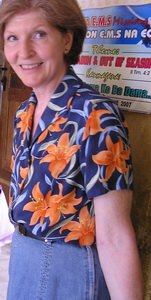
This
is my beloved Aunt Nancy. This is my mom’s brother’s
wife. Sweet as can be. With some theology that hits me like
fingernails on a backboard. She once told me that if I believed
enough, and if I prayed right enough, I could turn my coke into
cherry coke. “God, after all, favors his children and does
favors for them.”
That said, to Nancy,
one of the important things is making sure that all of God’s
children are taken care of. That God’s servants do the favors
for God’s children, so that all can be fed and educated. So,
because my mother takes this to heart, she adopted by sponsorship
this child,

named
Hope Bala. She has done this sponsorship with Kayla, in an effort to
pass on such wonderful theology.
I want to show you
this picture.
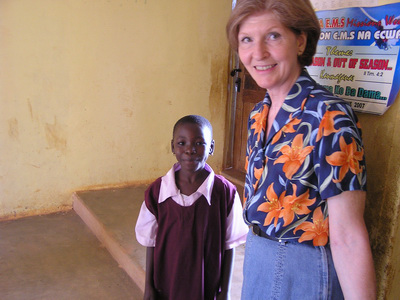
This
is Nancy with Hope Bala. Nancy and my Uncle John are missionaries in
Nigeria, Africa. They have done this since 1980. Uncle John is the
principal of the school where Hope gets daily education and food.
Nancy is the school/town nurse. We get their sponsorship letters, and
the theology that is in those letters still makes me cringe. But you
can’t argue with their action and with their service. And as
such, they are heroes of mine.
If you really want
to test your beliefs, or if you really want to feel them, turn them
into doing and serving.
Amen.