
| Easter Homilies, March 27, 2005 |

| Easter Homily: The Empty Tomb [1] John 20.1-10 Rev. Matthew M. Fry |
| Audio Files play in MS Windows Media Player 9, and need a high-speed Internet connection. |
| Time with the Children: The Easter Story, by jelly bean color. CLICK HERE |
| LISTEN to this Homily by Rev. Matthew M. Fry CLICK HERE |
| (The Anthem is between the homilies) |
As we continue to experience the Word of the Lord together, Let us Pray. Almighty God, the tomb is empty, you are alive. Be alive in us, both now and always. If these words are not Your Word, may they be forgotten and come to naught. But if they be Thy Word, may they adhere to our hearts, forever transforming us from glory into glory, into the creatures you would have us be, Thou who art our Rock and Redeemer, Amen.
Hear now The Word of the Lord as it comes to us in the gospel of John. Listen. John 20.1-10. The Grass withers, the Flower falls, but the Word of the Lord endures forever…Thanks be to God.
Darkness on the face of the deep. The formless beginning, the chaos. The void. The beginning. The wind and the word. God’s breath, God’s speech, summoning things never known before. Life and light. The first day. ‘In the beginning was the Word…and the word became flesh.’ The flesh has spoken, breathed, brought life and light. New creation has spilled out wherever Jesus has gone. The sixth day. Creation is complete. God saw all that God had made, and it was very good.
Flesh dies. Chaos comes again. Darkness descends on the small weeping group at the cross. Two men in the twilight do what has to be done. Then the long Sabbath, the rest in the cold tomb.
And now, still in the darkness, the first day of the week. The new week. The new creation. The eighth day. Eyes red from crying and sleepless nights. Women at the tomb; perhaps to bring the spices, perhaps just to weep, perhaps just to be there because there was nowhere else to be, nothing else to do, nothing else that ever mattered, that would ever matter.
Mary Magdalene, for all of her Da Vinci Code fame, doesn’t feature in John’s gospel until her appearance, with the other Marys, at the foot of the cross. John has written nothing of her history; the little we know, we have gathered from the other gospels. But her place here is spectacular. She is the first to bring the news that the tomb was empty. And, in the next section, an even greater privilege: the first to see, to meet, to speak with the risen master himself.
For the moment, the empty tomb is simply another twist of the knife. More chaos heaped upon what seemed like unbearable chaos. Someone has taken him away. No faith, no hope, no ‘maybe, after all…’ Just a cruel trick. Who took him? Mary Magdalene runs back into the city, back to Peter in his hideout, back to the young lad she had stood with at the cross, the one Jesus specially loved.
They run, too. (There is more running in these verses than in the rest of the gospels put together.) The younger one gets there first. Sure enough, the tomb is open and empty as reported. And the linen clothes are lying there. Not only did someone take the body, but they first went to the trouble of unwrapping it, which is no small task. Why on earth?
Peter arrives and does what Peter always does, act. He doesn’t take a moment to soak in the surroundings, he doesn’t pause to collect himself; he just comes right in the tomb. He notes the linens as well. Everyone stands around puzzled.
Then comes the moment. The younger man, the beloved disciple, goes into the tomb after Peter. And the idea about what must have happened, someone taking the body away but unwrapping it first, suddenly looks incredibly shortsighted. Something quite new surges up in the young disciple, a wild delight at God’s creative power. He remembers the moment for the rest of his life. A different sensation. A bit like falling in love; a bit like sunrise; a bit like the smell of rain at the end of a long drought. \\
A bit like faith. Sure, he’d had faith before. He had believed that Jesus was the Promised One, the Messiah. He had believed that God sent Jesus, but this was different. Verse 8, ‘He saw, and believed.’ Believed that new creation had begun. Believed that the world had turned the corner, out of its long winter and into spring at last. Believed that through Jesus God had said ‘Yes’ to the world. Jesus was alive again.
Everybody in the ancient world knew that resurrection couldn’t happen. It was impossible. They spoke of it as something one might imagine, but which would never happen, nor ever could. Same way I speak about the lottery. I always say, “When I win the lottery, I’ll get season tickets like those,” or “When I win the lottery, we’ll get a beach house and a mountain cottage,” or something like that. But I never play the lottery, which makes it even harder to win. Some things we talk about knowing they are impossible. Resurrection was one of those things for the ancient Jew.
When Jesus arose from the dead, he went into a new world, a new creation, a new life beyond, where death itself had been defeated, and life, sheer life, life in all its fullness, could begin at last.
Ask people around the world what they think is the biggest day of the year for Christians. Most will say ‘Christmas.’ That’s what our society has achieved: a romantic mid-winter festival (though, we don’t actually know what time of year Jesus was born) from which most of the things that really mattered (the danger, the politics) are carefully excluded. The right answer, and I wish the churches would find ways of making this clear, is Easter. This is the moment of New Creation. Easter is creation’s eighth day. If it hadn’t been for Easter, nobody would ever have dreamed of celebrating Christmas. Today is the first day of God’s new week. The darkness has gone, and the sun is shining. Amen.
1 This Homily, and the one to follow, borrow from Tom Wright’s book, John for Everyone Part Two: Chapters 11-21, Westminster John Knox Press, London, pages 140 – 147.
| Anthem: Sing Unto God: NPC Choir CLICK HERE |
| LISTEN to this Homily by Rev. Matthew M. Fry CLICK HERE |
| (There is another anthem after this homily) |
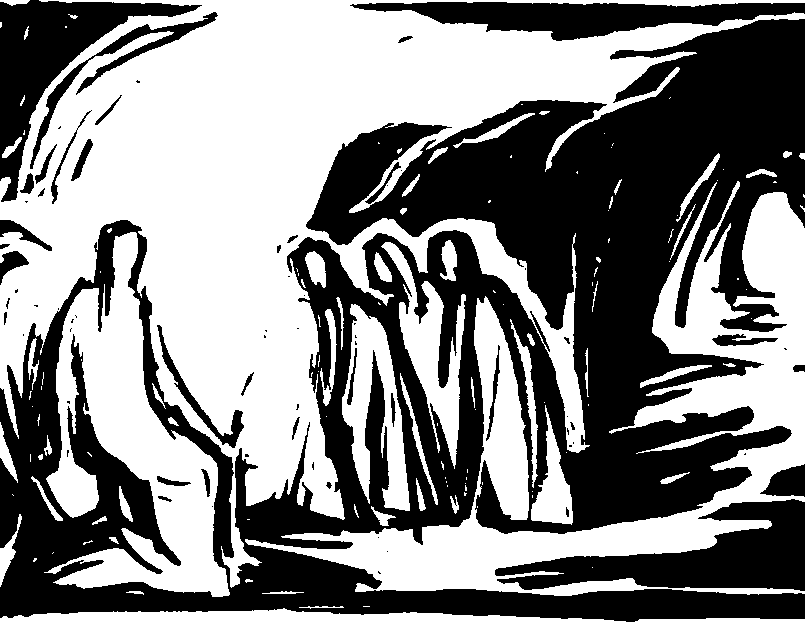
| Easter Homily: Mary Magdalene and the Risen Jesus [1] John 20.11-18 Rev. Matthew M. Fry |
Hear now The Word of the Lord as it comes to us in the gospel of John. Listen for God’s word for you today. John 20.11-18. The Word of the Lord…Thanks be to God.
“What should we call you?” Every Pastor, every associate Pastor, even most Christian educators get asked this question. “Do you want to be called Pastor Matt, or Pastor Fry, or Reverend Fry, or what?” I always said, “I’d like to be called ‘The most right and righteous Reverend Matthew Marshall Fry’, or in leau of that ‘His Royal Highness,’ but if neither of those fit, just call me Matt.” In my humble opinion, most pastors worth their weight request to be called by their first name. But everyone asks, and rightly so, so as to make sure what someone prefers.
Every Pastor has at least two or three folks that just don’t or won’t call them by their first name. I had one such person in Pittsburgh. “I just can’t call you Matt.” “Okay,” I said, “Reverend Fry would be fine, if that makes you more comfortable.” So to most folks I was Matt, but to a couple I was Reverend Fry. Until one day, during a softball team party. We had a terrible softball team there, so I’m not sure if we were celebrating softball, or that the season had mercifully come to an end. I was at the cooler grabbing a pop (here it’s coke, there it’s pop) and that same person wanted me to grab them a beverage. “Anybody want anything?” I asked. I looked over and it was clear that the words just wouldn’t come. Apparently, “Reverend Fry, if it isn’t too much trouble, I’d like a cold Coca Cola,” just doesn’t roll off the tongue. Whereas, “Hey Matt, will you get me a Coke?” does. “Reverend Fry, can you get me a beverage please.” No, that doesn’t come out. So, I was called Matt by that person from then on. Sometimes something happens, and you become on a first name basis, and a closeness in the relationship is established where calling someone by a title just won’t do anymore.
This passage in John gives us a moment like that. It’s a moment where something happens, and a closeness in the relationship is established. Jesus has called the followers disciples, servants and friends. Now that has changed. Listen again to verse 17: ‘Go and say to my brothers, I am going up to my father and your father, to my God and your God.’
Something has altered, decisively. Something has been achieved. A new relationship has sprung to life like a sudden spring flower. Disciples are welcomed into a new world, a world where they can know God the way Jesus knows God, where they can be cherished children with the Creator.
They can be, in other words, true Israelites at last. Israel’s calling was to be God’s children, God’s firstborn. Israel, like all of God’s children, struggled with that calling. The idea survives in Old Testament writings that as God’s child, Israel had experienced an estrangement. But Jesus has now made a way back to the father’s house. And everyone who follows Jesus is welcome there in his name, as a beloved son or daughter.
Mary Magdalene stands at the tomb as she weeps. Where had the angels come from? They hadn’t been there a few moments before, when Peter and John had been inside the tomb. Or maybe they had been. Maybe sometimes you can only see angels through tears. And then there is a strange figure standing there. Who is he? What is he doing?
Mary’s guess, that he must be the gardener, was wrong at one level, and right, deeply right, at another. This was the new creation. Jesus is the beginning of it. Here is the new Adam, the gardener, charged with bringing the chaos of God’s creation into new order, into flower, into fruitfulness. Jesus has come to uproot the thorn and thistles and replace them with blossoms and harvests.
He is alive, with a new sort of life, the like of which we’d never seen before. Mary carries out the instructions to tell the others. I’ve seen the master, and this is what he said. Nothing like fresh, first hand evidence, especially when the news is so good.
And it is still good today, fresh today, and we give first-hand evidence of how the new creation has given new life to us. If someone in the first century had wanted to invent a story about people seeing Jesus, they wouldn’t have dreamed to give the star part to a woman, let alone Mary Magdalene. So maybe we shouldn’t be surprised that the rag tag group that is the church gets to be the one passing on that evidence today. God is good…Amen.
1 This Homily, and the previous one, borrow from Tom Wright’s book, John for Everyone Part Two: Chapters 11-21, Westminster John Knox Press, London, pages 140 – 147.
| Anthem: Christ is risen!: Youth Choir and Adult Bells CLICK HERE |
right corner of the translation window. That will close it. You will
then return to the English version.
| Published March 31, 2005 |


 |
 |
 |
 |
 |