| Sermon, March 20, 2005 |
| Give Us Braveheart[1] Luke 23.13-25 Rev. Matthew M. Fry |
| Audio Files Use MS Windows Media Player 9, and need a high-speed Internet connection. |
| Time with the Children: Love Instead of Winning CLICK HERE |
| Anthem: Triumphant Acclamation: Youth Bells CLICK HERE |
| LISTEN to this Sermon by Rev. Matthew M. Fry CLICK HERE |
As we continue to experience The Word of the Lord together, let us pray. Insightful Spirit, open our minds to the wisdom we may receive from hometown prophets. Touch our hearts with healing gifts that you have granted to our neighbors, so that your work may not be obstructed. Speak to us now Lord, with your insightful word, so that we might grow in you. If these words are not Your Word, may they be forgotten and come to naught. But if they be Thy Word, may they adhere to our hearts, forever transforming us from glory into glory, into the creatures you would have us be, Thou who art our Rock and Redeemer, Amen.
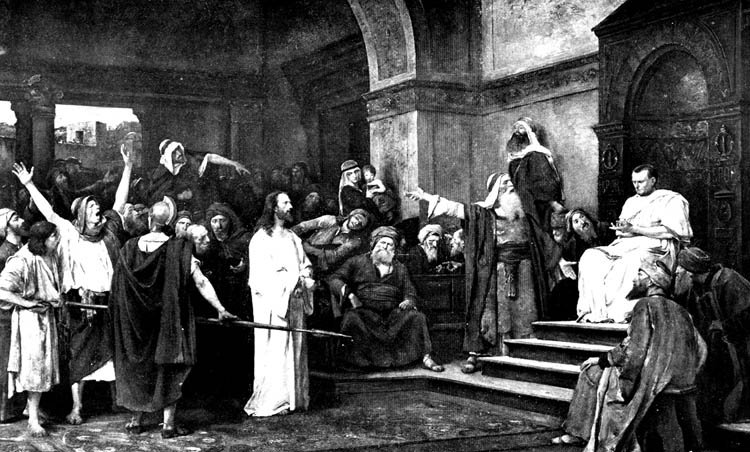
Hear now The Word of the Lord as it comes to us in the gospel of Luke. Listen for God’s word for you today. Luke 23.13-23. The Grass withers, the Flower falls, but the Word of the Lord endures forever…Thanks be to God.
I did not know that Jesus had perfect teeth. In my years of Biblical research, countless semester hours spent studying the gospels, I never ran across the evidence, until I saw Mel Gibson’s movie, The Passion. The Passion is still a topic of discussion over a year after its release, with all the talk now about the snub that it got from the Oscar Nomination Committee. I didn’t even notice the perfect teeth myself at first, someone pointed it out. Jesus, like all Hollywood starts, had beautiful, perfect teeth. Barabbas, on the other hand, horrible teeth, which we could be sure meant foul breath. That to go along with a nasty, foul personality. Barabbas also had filthy hair, dirty clothes, a big nose and those bad teeth. He was one ugly hombre.
Why is that? Well, that’s Hollywood, for one thing. In most movies, this one included, good people are beautiful, bad people are ugly. How else could we tell if someone will turn out good? And Barabbas in the movie was one ugly, bad dude.
Not only in Hollywood, also in church. The charges brought against Barabbas have been inflamed and inflated over these 2000+ years. I asked a few folks here at NPC, “Who was Barabbas? What did he do to get himself arrested?” Most of you got it right. “He was a rabble rouser, an insurrectionist” which is an interesting term in today’s climate. So I asked some other folks. “He was a thief,” was an answer and, “a no-good-nick,” which was a personal favorite. But the general consensus there was that he was a criminal, a murderer.
According to the Bible, Barabbas was a “stasis”, the Greek word, and a “phonon.” While phonon means murderer, stasis means insurrectionist, or rebel. Barabbas led a rebellion that grew in popularity and strength until some people got killed. Barabbas watched the daughters of Jerusalem violated by the occupying soldiers of Rome; he observed the sons of Abraham arrested and beaten with no cause. Under the cruel authority of Pontius Pilate, and the look-the-other-way policy of Herod, he suffered, and endured, and then – enough! I don’t suppose that it would take much to rally a group of would be warriors. They could at least start something, and if momentum gathered, who know how this thing might turn out. Things turned out badly, and Barabbas was in chains, awaiting the gentle justice of Rome to execute his punishment.
Do you believe in reincarnation? I do not. But if I did, Barabbas would be my poster child for it. Barabbas made a later appearance in this world in Scotland in the year of our Lord, 1314. While there was no love between the Scots and the ruling English, in those days, the British King Edward made things intolerable when he gave the English nobility the cruel right of “Prima Nocta,” that allowed them to sleep with all new brides on their first wedding night. Tired of a “hundred years of murder, theft, and rape,” one Scotsman, William Wallace, transformed from peaceful farmer to a brutal leader of the fight for independence. Aided by Robert the Bruce, Wallace waged a very personal, very bloody rebellion against King Edward the First. I have a wee bit of Scottish blood in me heritage, and when I saw the peasants of Scotland, starved and outnumbered, charge the fields at Bannockburn, I cheered. They fought like warriors; they fought like Scots.
Did you see the movie? It was called “Braveheart” and it starred Mel Gibson. Barabbas, Braveheart; were they not the same character, rebelling against cruelty and tyranny? Roman Empire, British Empire – only the names have changed.
On another continent, 450 years later, the story is the same again. Benjamin Martin, a gentle farmer, loving father, grieving widower, simply wants to be left in peace to raise his crops and his boys. But Colonel Tavington of the occupying British force slaughters innocent townspeople, including Martin’s oldest son. Martin is enraged and slaughters a few soldiers in retaliation. The British turn up the heat, and Martin is forced to kill a few more soldiers. The movie was released on Independence Day of 2000, and I tell you, I was not the only one proud to be an American.
Did you see the movie? It was called “The Patriot”, and it starred…Mel Gibson. The Patriot, Braveheart, Barabbas – across the centuries, the same hero appear in history to protest, no, to rebel – against tyranny and cruel abuse. Sometimes, oftentimes, people get killed in the process.
So, why is Barabbas the only one with bad teeth? Why didn’t Mel Gibson cast himself as the character Barabbas? He’s made a career playing that role. Heck, as he said after he was not only nominated but won for best Director for Braveheart he said, “I’d like to do what every director wants to do, I want to act.” But I’ll tell you why he didn’t play Barabbas. We would have had a hard time choosing between Mel Gibson and Jim Caviezal – I mean between Barabbas and Jesus. “Who do you want me to release to you?” asked Pilate. Foolish crowd. Mindless mob of bought-for-a-price rabble. We would never have chosen Barabbas – never. Not with those nasty gingivitis producing teeth.
There was another choice being made that day, unspoken, but with greater influence on people than any pay-off bribes. At the time of Jesus, there was one being accepted by millions of people as Divine, Son of God, God, and even very God of very God. Hailed as Lord, Redeemer, Liberator, even Savior of the World, Roman emperor Octavian, later known as Augustus Caesar ruled the world with absolute power, the way God should rule the entire world. The core of his belief system was this: peace through victory. This was and has always been the accepted norm of civilization.
Peace through victory – by peace I mean more than world peace, though world peace is included in the term. Exchange the word “life,” or “satisfaction,” or “contentment” if you like. Peace consists of two inseparable parts: inner peace – the deep personal sense that life is good and worthwhile, that life means something and the something it means is noble; and peace with others – our relationships with neighbor and family and community are marked by trust and mutual respect and well-being.
You cannot have one with the other, for what kind of person could feel good inside while watching a bully torment a weaker person, or seeing a friend’s house burn to the ground? Moreover, what would it profit a person to expend energy in service to fellow humans, benefiting them in numerous ways, if they cannot rest at night because of the despair and sorrow in their own heart?
Inner peace, peace between neighbors, world peace, the whole 9, the people of Rome were convinced that peace came through victory. People have always believed that; it is both the norm of ancient kingdoms and the cutting-edge of modern civilization. Peace through victory.
Jesus proclaimed a different kingdom of a different God. He strode out of the heart of God’s people into Jerusalem to announce that his kingdom did not have to wait until it conquered the world – “The kingdom of God is already among you…” One could live in that kingdom right here and now, but it was and is a very different kingdom, a radically new way of living. Not peace through victory, but peace through suffering love.
Listen carefully – not peace through suffering, but peace through love. Love that is willing to suffer in the name of love. Love that is steadfast, strong, faithful, will always suffer, eventually. Romantic, Hollywood-style love will cut and run when it gets tough; true love, love that matters, will remain steadfast, even when the cost is great. Real love, sooner or later, will always cost you suffering.
Two possibilities for life; peace through victory or peace through suffering love. These are the two fundamental options for the pursuit of life, liberty, and harmony with God.
There, in Jerusalem, on Passover week, we see demonstrated what peace through victory ultimately does – it will hammer you. It will beat you up. It will crucify you. Even if you are so victorious that you conquer the world, this is what peace through victory ends up doing. It isn’t pretty. But it’s true. Strip away the finery and the protocol and the trappings of power and this is what the pursuit of peace through victory looks like. Somebody will get crucified. There, in the city of Jerusalem, on Passover week, we see demonstrated what peace through victory does.
There, in the city of Jerusalem, on Passover Week, we see demonstrated what peace through love does. Jesus, standing before Pilate, with the sound of the mob’s cries echoing through the courtyard, embodies love that will not cut and run, love that will not stop loving. Jesus embodies love the way God loves. Jesus taught that life comes through love of neighbor, of God, of self, and now he stands on what he taught – peace through love. But beware, look, follow the way of love and you will suffer, you will be beaten, you may even be crucified, but not even the grave will contain you. They may kill you; but they cannot take away your life.
Those were the options in the city of Jerusalem, in the courtyard of Pontius Pilate; those are still the options offered today. Barabbas and Caesar – they were on opposite ends of the power spectrum, but they operated under the same principle: peace through victory. Peace through striving, overcoming, flexing muscle. Caesar was successful at it, Barabbas less so, but they flew the same flag: peace through victory.
The other option offered was very different: peace through love that is willing to suffer. Jesus or Barabbas. Though I want to deny it and avoid it in every way I can, just like the crowd in Jerusalem, we have always cried, “Give us Barabbas!” “Give us victory! At least give us a hero who will fight for victory, not only who whimpers, ‘Father forgive them…’”
So I would give Barabbas crooked teeth and bad breath, I grant him legendary status as a petty thief and vagrant hoodlum. I make him as different and as far removed as I can, because I don’t want to acknowledge just how close to my own heart this is. I don’t want to recognize how often in my own life I opt for the pursuit of victory. Oh how I have cried out silently from my soul, “Give me Barabbas.”
Can’t I choose both? Can’t I have some of each – a kind and gentle victory, a benevolent love that only flexes its muscle when absolutely necessary? Why can’t I serve two masters? But Pilate only offers one to be released, and we hear ringing in our ears, “No one can serve two masters, for you will love one and hate the other…”
Both the teachings and the death of Jesus are very clear on this: if you choose the way of love, you will come into conflict with the pursuit of victory; if you opt for the pursuit of victory, you will be forced to deny your commitment to love.
I know that it’s very easy to think political with this sermon. “Do you mean we should not have responded to the terrorism of 9.11?” “Are you preaching against the war in Iraq?” We could go there if you wanted. I mean heck, if we can’t keep Barabbas way off in Jerusalem, at least we can take him as far away as Washington. But I don’t want to give you that out. I want this to be much closer to home. If we say we choose Jesus, the way of suffering love, why then do we spend so much of our energy and our lives in the pursuit of successful victory? We do it in the office, at home, even in church. Why is it so important that we be winners?
In coming to the end of this sermon, I want to leave us with good news. I want us to be strengthened and encouraged, feeling glad that we came to worship today. But this is Passion Sunday, the last week of Lent. Next Sunday is Easter. Next Sunday we celebrate that no matter what we choose, no matter how persistently we whisper “Give us Barabbas,” the unconquerable suffering love of God overcomes all. The way of love brings life that the cross nor the grave nor hell itself can destroy. But the only authentic route to Easter includes a stopping point at Passion Sunday, and a hard journey via Good Friday. Today we try to open our eyes to the truth, whether the particular name is “Mel” or “Braveheart” or “The Patriot,” O how we cry out, “Give us victory, Give us Barabbas.”
Until next Sunday then, Easter Sunday, listen for these words, and ponder if the Savior was looking you right in the eye as he prayed, “Father, Forgive them, for they have no idea…”
1 This sermon is borrowed from one very similarly preached by Dr. David Fry, Pastor, Pleasant Hill Presbyterian Church, on Sunday 4 April 2004.
| After reading the translation: Click on the [X] in the box in the upper right corner of the translation window. That will close it. You will then return to the English version. |
| Published March 22, 2005 |


 |
 |
 |
 |
 |