| Sermon, March 13, 2005 |
| Bring It On Ezekiel 37:1-14 Jerrod B. Lowry |
| Audio Files Use MS Windows Media Player 9, and need a high-speed Internet connection. |
| Time with the Children: Scars are reminders CLICK HERE |
| Anthem: Poor Man, Lazurus: Youth Choir CLICK HERE |
| LISTEN to this Sermon by Jerrod B. Lowry CLICK HERE |
Ezekiel is an OT priest and prophet who writes after Babylon’s first conquest of Judea, which allowed the Babylonians to enslave many of the Judeans. Those Judeans taken were the leaders and the influential of Judean society. Those left in Judah protested and attempted a rebellion that failed and led to the destruction of Jerusalem including the Temple in Jerusalem, and a second round of enslaving the prominent of society that had been left in Judah after the initial conquest. This left Judah devastated politically, economically, and spiritually. Ezekiel was one of those taken the first time, because he was a member of the priests who ran the temple in Jerusalem. And the book of Ezekiel is believed to be his letter, a collection of visions and prophesies, to the people left in Judah. A letter designed to bolster sagging hope and pride.
Let us listen attentively to Ezekiel’s words in the manner that I’ve rewritten them so that clear distinctions are made between which character is talking, and this version I’d like to call the Jerrod Lowry Standardized Version. But also participate with me in this reading. A Hebrew word RUAH is used many times in this passage to mean breath, wind, and spirit. So when you hear either of these words (breath, wind, spirit) I want you to shout RUAH!
BREATH__WIND__SPIRIT__HEART (testing)
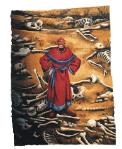
“The hand of the Lord was upon Ezekiel and the Lord brought Ezekiel out by the Spirit of the Lord, and set him down in the midst of the valley; it was full of bones. And the Lord led Ezekiel among the bones; and Ezekiel noticed there were very many bones in the valley, and lo, they were very dry. And the Lord said to Ezekiel, “Son of Man, can these bones live”? And Ezekiel answered “Why you askin’ me you already know.” Again the Lord said to Ezekiel “Prophesy to these bones, and say to them, O dry bones, hear the word of the Lord. And this is the message the Lord had for the bones: I will cause breath to enter you, and you shall live. And I will lay sinews upon you, and will cause flesh to come upon you, and cover you with skin, and put breath in you, and you shall live; and you shall know that I am the Lord.” So Ezekiel prophesied as the Lord had commanded; and as he prophesied, there was a noise, and behold a rattling, and the bones came together, bone to its bone. And as Ezekiel looked, there were sinews on them and flesh had come upon them and skin had covered them; but there was no breath in them. Then the Lord said to Ezekiel, “Prophesy to the breath, and say to the breath, “Come from the four winds, o’ breath, and breathe upon these slain, that they may live.” So Ezkeiel prophesied and the Lord commanded and the breath came into them and they lived, and stood upon their feet, an exceedingly great gathering. Then the Lord said to Ezekiel, “Son of Man, these bones are the entire house of Israel. Remember when they were complaining “Our bones are dried up and our hope is lost because we have been CUT OFF!” Therefore prophesy and say to them Ezekiel “Behold the Lord will open your graves, and raise you from your graves, O my people; and the Lord will bring you home into the land of Israel. And you shall know the Lord when the lord opens your graves and raise you from your graves, O my people. And the Lord will put the spirit within you, and you shall live, and the Lord will place you in your own land; then you shall know that the Lord has spoken, and has done all these things for you.
I believe few of you know that for an entire semester of my college career I was a Motivator for Athletic Gatherings. It was my job along with my co-workers to rally the congregation of Winthrop University’s basketball faithful with inspirational anecdotes designed to pluck at their heart strings and rise to their feet in a cacophony of adulation in order to wisp our beloved college basketball team onward and upward to victory. YES, I was a cheerleader! And while at the summer cheer camp a movie about cheerleading came out, and I went with my colleagues to see it. The movie was called Bring It On. It was about two cheerleading teams, one white from the suburbs and one black from the inner city. And for years the suburb team would steal the cheers from the inner city squad and use them to win the national cheerleading competitions, like the ones that ESPN shows now that football season is over. But when the squad from the inner city realizes they are being robbed of their cheers they confront the suburb squad at the movie’s climax. In this scene the two cheerleading captains get face to face in a showdown designed to challenge the opponent to see who really had the SPIRIT. And so one leader dares the other to BRING IT ON, and the challenged leader promises that she’ll bring it! Now both squad captains have just put their reputations on the line and only now do they both begin to contemplate in the back of their own minds that they are not prepared for the fight they just asked for. But the stage is now set, they have to prepare because they dared and asked to BRING IT ON!
Now I’m sure you’re wondering what in the world does cheerleading have to do with Ezekiel. So let’s dive into Ezekiel to find out. This passage in Ezekiel is probably one of the best known stories from the Bible. If this is the first time you’ve heard the actual story, I’m sure you’re familiar with that wonderful Sunday school or VBS song “Them Bones them bones them dry bones”. And every sermon that I’ve ever heard about the “Valley of Dry Bones” was used as a passionate message, from the preacher, to explain the incredible power and authority that the individual who hears the voice of the Lord can possess. And I’m almost certain it is simply a strange coincidence why a pastor would believe that to be the crux of this message, not as a yet another opportunity for a pastor to assert their authority, but maybe that is the whole point of the story. To do this the reader must see the text as if there are only two characters, Ezekiel and the Lord. But when you look at this text from the perspective of the third character you really get another story all together. The people as played by the bones are the third character of the story. And the reading of this story from the perspective of the people from the vantage point of the bones, refocus the story on the presence and importance of the RUAH. But what is this RUAH? How do we, today, understand and expect the RUAH to appear and function? Do we really have the RUAH? And what would happen if we dared God to allow the RUAH to have its way in our lives? Therefore it is my contention today that understanding the actions of the RUAH in this Ezekiel passage will give us clarity concerning the true power of the Spirit, the work the Spirit can have in our personal circumstances, and how the Spirit can affect our perceptions of the institution that is the church.
From our scripture reading we know that the RUAH is the Hebrew term used to speak of the wind, breath, or even the Spirit of God. Yes this is the very same Holy Spirit that we talk about today. This is the same Holy Spirit that most people believe allows them to talk in OTHER if not strange languages, and not necessarily unknown languages to the speaker but known to someone in the speakers presence as occurred in the book of Acts, but all together new languages in the form of babblings. And yes this is the same spirit that people today, especially in my African-American context, believe causes them to dance or even “fall out” in an apparent spirit enduced trance, even thought there is not mention of the spirit ever causing someone to “fall out” in the Biblical witness (get naked, yes; fall out, no – 1Sam 19:23,24). Apparently we have misconceived the move and work of the spirit or we have found a different spirit than the Spirit recorded in the Bible. We understand this especially as it relates to this story in Ezekiel where the bones would testify to us today that the presence of the Spirit did not give them utterance or cause them to fall out. As a matter of fact the bones were already down. These bones were symbolizing the Jews of Ezekiel’s day who were in a state of chronic depression as low as can be expected, in other words in the Valley.
The valley is not the best place to be in. As a matter of fact if you had real-estate in the valley then you had a worthless piece of property. Spiritual real-estate is also about location, location, location. The location of the valley is as symbolic as the notion of bones. The valley in the Biblical text is actually a place that is as far from God as can be expected. If you recall the writer of the 23 Psalm feels that even on his worst days that God can find him to comfort him as he records “Yea thou I walk through the valley of the shadow of death…”. The valley tends to be a place associated with despair and death. A place that is Godless. For the Psalmist (121) who is in this valley of despair also writes that God is in the high places as he suggests according to the KJV “I look to the hills from which cometh my help, because my help comes from the Lord”. So we understand that the valley is a place associated with despair and death, a place considered Godless. The valley is a place that we will inevitably spend some time that is if we don’t feel as if we are in a valley now. What are some of our life’s valleys? What are some of the things that make us feel as if we are separated from God. When to do we feel as if we are stripped of our protective skin and forced to lay naked and ashamed to bake in hopelessness before a blazing sun of failure or criticism.
It is in these moments that we feel as exposed as bones unrobed of their skins. Being bones laid bare exposes us for people to see who we really are with out the protective guise and masks that we make for ourselves to hide our true identity. Sometimes we may feel as if the power to move out of our predicament has been robbed from us because we don’t even have the sinews, the connective tissue like joints (often associated with power) to pick ourselves up from the depths of our valley.
It is in this valley of the downtrodden and discarded of society that we not only find ourselves but should recognize that we are not alone. As we lay in our valleys we should look around to see that our bones actually lay upon the bones of others in the same valley as the one in which we find ourselves. We should recognize that the weight on top of us is not the stress of excessive contemplation about our predicament but the weight of new bones that fell into our valley after us. And in a sense even though we are in the valley of sorrow and hurt we ought to realize that we are not there by ourselves. We feel as if we are alone in the valley because our primary concern is trying to figure out WHY AM I HERE and HOW DO I GET OUT. But if we reach beyond the gaze of selfishness and self concern we’d realize that there are others in the same valley wrestling with the same issues for which we struggle. Even when we feel as if God has abandoned us we ought to realize that we are not alone, nor are we the first to endure the pain of our struggles. For if there is nothing truly new under the sun, as Ecclesiastes tells us then you are not the first nor the only one to ever reside in your valley.
The Bible even gives us a steady listing of people who have posted tents and taken up residence in your valley. As a matter of fact Biblical scholars might agree with me that the entire Biblical story is one that is written by those in the valley. And that is why we see Job who looses his children, family, and health; struggling with his spiritual location in the valley. Many of the women, like Sarah, Hannah, and Rachel are valley dwellers as they question God concerning delayed promise of progeny. Jeremiah, Isaiah, Amos, Hosea, and all the prophets lived in the valley as they toiled concerning the peoples stale and soured relationship with God. And if we stretch our focus of concern to view our valley counterparts we would even find the footprints of our savior running through our valley. And while the notion of knowing those who had been here before and even those who are here with us now is hope-filled it does not lead us to restoration.
As shown in the text the embodiment of restoration comes when the spirit is present. It is by the power of the spirit that we are rendered, skin or protection from some of life’s hardships. It is by the power of the spirit that we are figuratively given sinews, which provides us the ability and the power to even stand. And more importantly it is by the power of the spirit that we are charged to stand together as displayed in verse 10. When the spirit of the lord came they stood together as one house, united. This house is a collection of restored beings with new skins, and new powers that have formed over the old dry bones of sorrow and despair.
First note that even after the restoration by the spirit the bones were still there. In AA meetings alcoholics declare with pride that they haven’t had a sip of alcohol in so many months but they still acknowledge themselves to be alcoholics. In similar fashion, we the former bones on the valley floor, wrapped in the skins of our Sunday bests and embued with the power of grace are still covered over bones. We may no longer reside in our valley but the bones are still within us. We even sit here today confessed and grace redeemed sinners, but still sinners.
Second, and more importantly these broken people, as a response to the presence of the spirit, stand together. The presence of the spirit builds community. A community of the broken and the brokenhearted. And to this community the Spirit welcomes everyone. And it is because of this that I’m not sure if we as a church globally really want the spirit, or at least the spirit of the Bible, and the spirit as declared by Ezekiel. If we ask for the presence of the Holy Spirit in our lives do we really know that we are opening the doors of our lives and our church for others, and specifically for those people. You know those people. Them! The ones who are not us and not like us. The ones who don’t look like us. The ones who don’t talk like us. The ones who speak five different languages and the ones that speak one language and it is not English. The ones who don’t live in our neighborhood. The ones who didn’t finish school and the ones who have twice as many degrees as we do. The ones who smell funny and the ones who smell better than us. The ones who would have to walk miles to get here and the ones who would be driven in limousines. The ones who couldn’t afford summer camps, ski trips, or mountain retreats. The ones who’ll disappear in the summers to live in lake and beach front cottages. Those people! (The people who feel like the government works for them so it must work for everyone too and those who feel the system is set up to work against them.) Or the ones who can’t come every Sunday because they’d have to work even on the Sabbath just to pay bills. Or the ones who’ve never worked a day in their lives thanks to trust funds and silver spoons. Or the ones who have to work in illegal underground industries because minimum wage doesn’t meet the standard of a living wage. Dare we ask for the Spirit that will unite us with those people. I know that I’m a sinner but dare we ask for the spirit that will beckon us to share a sanctuary with society’s outcast, or even those who are not us. Dare we stand at the gateway of our lives like the Statue of Liberty and say “Bring On your tired, your poor, your people yearning to be free”. Dare we invite all comers to stand with us, not to change them to look, think, act, or talk like us but to celebrate the diversity that they bring. Can we truly say “whoso ever will let them come”! Shall we challenge God to Bring it on. Bring on the Spirit! Bring on the cultural and ethical diversity. Bring on economical and socio-economic diversity. Bring on the different life styles and even sexual orientations. Bring on the Holy Spirit!
| After reading the translation: Click on the [X] in the box in the upper right corner of the translation window. That will close it. You will then return to the English version. |
| Published March 14, 2005 |


 |
 |
 |
 |
 |